Published books, syndicated industry reports, and downloadable executive briefs — the body of work that informs and accompanies the consulting practice. Most assets are free; commercial titles link out to their respective storefronts.
Featured long-form work on cyber-physical systems, emerging and exponential technologies, and the architectural lens that informs the Ronna-X practice. Available in Kindle and paperback formats via Amazon.
A three-volume long-form survey of the emerging and exponential technologies that run underneath the Ronna-X practice — cyber-physical systems, agentic and physical AI, cooperative perception, and the cross-domain architectural reasoning required to ship modern System-of-Systems programs. Each volume stands alone; together they form a single architectural reference.
Future long-form titles aligned with the Ronna-X practice — from Vol 03 (Power Sovereignty as Physical AI) to deeper monographs on federated testbeds and cooperative perception. Subscribe to be notified at release.
Commercial industry research from the Ronna-X practice. Premium reports focused on cross-domain architectural theses, distributed via Gumroad with instant download.
An unvarnished audit of why legacy telecom forecasting is obsolete. The 5G→6G transition is not a consumer bandwidth upgrade — it is a fundamental architectural rewiring of the global industrial economy as critical infrastructure moves toward a fully autonomous, Human-out-of-the-Loop (HOOTL) paradigm where probabilistic best-effort networks become a severe financial and physical liability.
The report maps the exact technological blockages and the proprietary 6G engineering resolutions required to unlock the projected $12.3 trillion automated economy by 2030, across:
Future commercial reports from the Ronna-X practice — typically cross-domain architectural theses on Physical AI, federated testbeds, smart-grid sovereignty, and the topology behind autonomous mobility at L4+ scale. Subscribe to be notified when new titles are released.
Independent industry briefs anchored to public 3GPP TSG#112 outcomes — Rel-19 NTN Phase 3 deployment readiness and the Rel-21 6G spec timeline. Vendor-neutral; suitable for operator, OEM, and ecosystem outreach. Free to download, attribute-on-use.
Post–TSG#112: Rel-19 NTN is frozen; Rel-21 has a calendar. The bottleneck moved from spec freeze to field proof when geometry, Doppler, and handover windows move together. This v3 brief maps a device-class × NTN-type trial table, public partnerships status, ecosystem buyer map, and seven validation challenges — plus the study-to-spec bridge operators need before Rel-21 Stage-2 freeze.
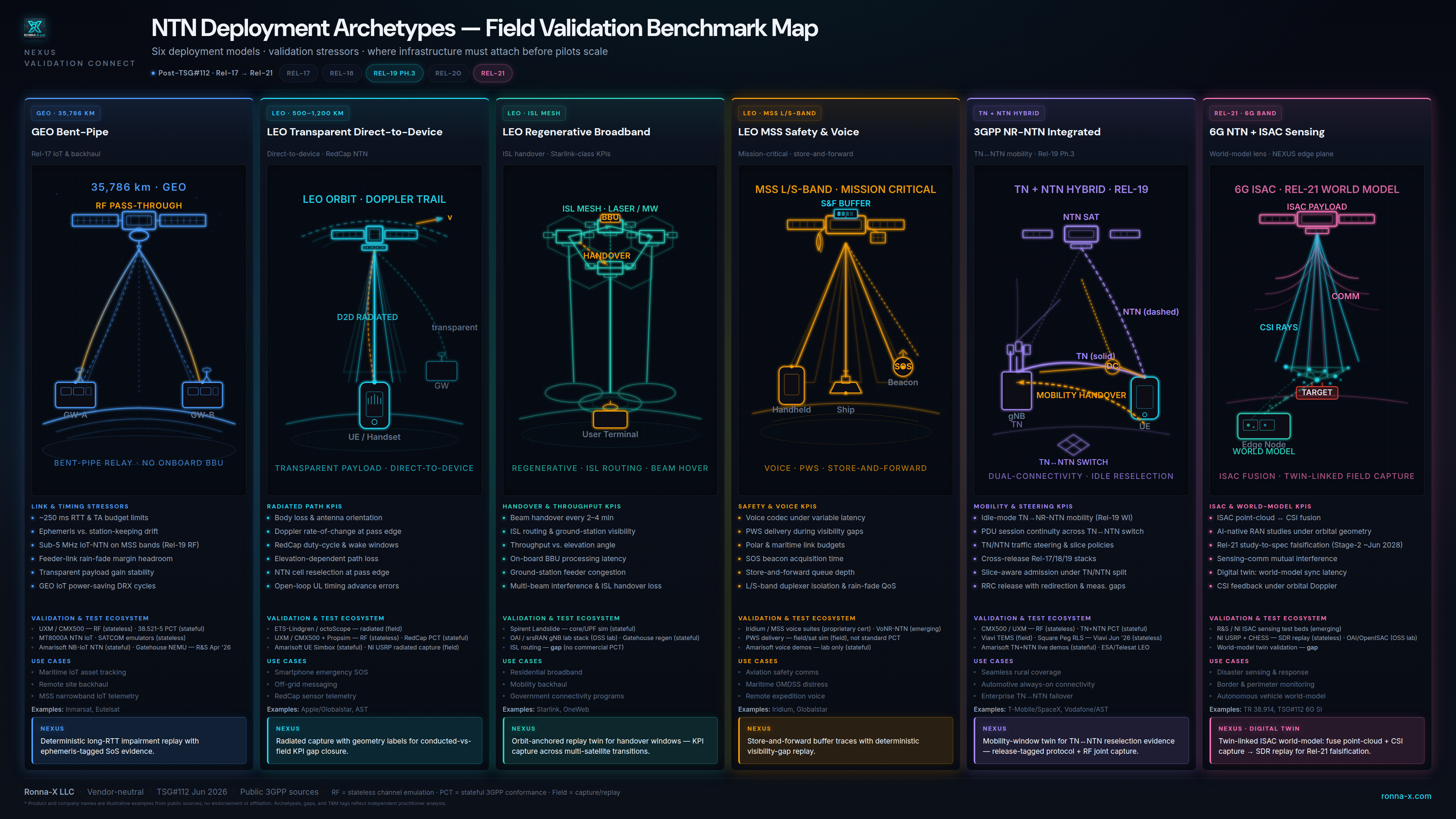
Six NTN deployment archetypes mapped through a field-validation benchmark lens — not a market-segment infographic. Each column: architecture diagram, KPI/stressors, validation & test ecosystem (stateless RF · stateful PCT · field capture), market use cases, ecosystem examples, and NEXUS hooks. GEO bent-pipe · LEO transparent D2D · LEO regenerative broadband · LEO MSS safety/voice · 3GPP NR-NTN integrated · 6G NTN + ISAC sensing.
Product and company names are illustrative examples from public sources; no endorsement or affiliation. Independent practitioner research — Ronna-X LLC.
For mobile and satellite operators: Rel-19 NTN Phase 3 is deployment-ready and Rel-21 6G has a fixed spec timeline. The commercial shift — wholesale and roaming with SNOs, direct-to-device ARPU on smartphones, enterprise private 5G plus satellite backhaul — is now a line item, not a slide deck. Maps the MNO/SNO ecosystem, chipset–handset–operator collaborations, alliance structures, and where budgets attach in 2026–2028.
The Ronna-X industry-reference series — quarterly executive briefs developing cross-domain architectural theses with operator-side framing. Document-first publishing is the default; LinkedIn is the amplification layer. All briefs are free to download, attribute-on-use.
The cross-vertical thesis: SDV, AAM, and Robotics share the same topology (System 1 + System 2 + Cooperative Perception commons) but require different infrastructure. Three architectural schools, Houston regional spotlight, six-path framing, and four engagement formats.
The first Ronna-X volume. On-prem and edge AI as the credible path for industrial physical-AI deployment. Key Performance Validation (KPV), non-intrusive edge attestation, SoS lens for manufacturing and energy operators.
The same topology applied to the smart grid: SDG → AIDG. AMI / PMUs as the cooperative-perception commons. Protective relays as System 1. AI dispatch as System 2. The grid as a sovereign physical-AI system.
Public-facing practice documents — capability overviews, service menus, statement-of-work templates. Suitable for sharing with procurement teams, partners, or as warm-intro context.
A public-facing capability overview suitable for sharing with prospects, procurement teams, or as a warm-intro attachment. Sectors, timeline, and engagement posture without proprietary IP.
The 1-page services overview — engagement formats, indicative pricing, and standard scopes (Executive Briefing, Diagnostic Sprint, Build Sprint, Fractional Advisory). The page-4 of the Vol 02 brief in standalone format.